







|
| Musical Musings: Liturgy |
A New Liturgy of the Hours
Adding to the convenience was a shorter compilation, including just Morning Prayer [Lauds], Evening Prayer [Vespers], and Night Prayer [Compline], in a one-volume version called Christian Prayer. This allowed parishes and other organizations to easily pray the hinge hours of the Office (Morning and Evening Prayer) on a regular basis. Night Prayer became a convenient way to end parish meetings. After a fifty year longevity (huge in the world of English liturgical texts), the Divine Office was ready for a make-over, owing to the release of the Roman Missal — Third Edition (2000/2010) and Liturgiam authenticam (2001). The new Missal was promulgates in 2000 in Latin, with an English translation more attuned to the Latin original than the 1975 version released in 2010. With subsequent issuance of texts for Baptism, Confirmation, Weddings, Funerals, etc, the texts for the sacramental rites of the Church were updated. The other half of the liturgical prayer life of the Church, the Divine Office, was sorely outdated. In 2012, the USCCB voted to revise the Liturgy of the Hours in light of Roman Missal — Third Edition and Liturgiam authenticam. This process, in its various stages, took thirteen years to complete. Finally, on May 29, 2025, the Memorial of Saint Paul VI, the full manuscript of the Liturgy of the Hours — Second Edition was transmitted to the Holy See for approval. On October 18, 2025, the Dicastery for Divine Worship and the Discipline of the Sacraments officially confirmed the new English translation and allowed for its publication. So What's New?Just as when the new translation of the Mass was used in 2012, one will find that the English much more closely aligns with the Latin original. A translation technique, called "dynamic equivalence," was used extensively in the 1970s for the first translation of the Mass from Latin. Phrases, translated for sense-meaning rather than literally, often veered far from the mark of the Latin text. This technique was refuted by the Vatican document, Liturgiam authentican, which demanded more faithfulness to the Latin original. This led to wordings like "consubstantial with the Father," as a translation of consubstanialem Patri, rather than "one in being with the Father." Three recent liturgical volumes will be incorporated into the new English translation of the Divine Office:
These will be the standard English editions for liturgical use in the United States. The latter two will eventually see inclusion as the Responsorial Psalms and the liturgical readings at Mass. This thirteen-year translation process of the 2000 Liturgia horarum, begun in 2012, was completed in various segments, voted on by the U.S. bishops in a piece-meal process, and eventually sent to the Vatican for overall confirmation in 2025. Sacred Scripture== Psalms ==After years of work by the Benedictine monks of Conception Abbey in Missouri, and further years of trial, a new edition of the British Grail Psalms was completed. In May 2018, the Revised Grail Psalms were confirmed by the Holy See. These will be used for all the Psalmody in the new Divine Office transaltion, and eventually, as the Responsorial Psalms at Mass. These are "known for being remarkably faithful to the original Hebrew while also being rendered in a 'sprung rhythm' to facilitate singing." Renamed The Abbey Psalms and Canticles, they are available in published form from Ascnesion Press and Magnificat.
Here is a sample from the book:
The Abbey Psalms and Canticles by the Monks of Conception Abbey == Canticles ==Also approved by the Holy See in May 2018 were the Old Testament and New Testament Canticles for use at Morning Prayer and Evening Prayer, both as portions of the Psalmody and as the Gospel Canticles that mark the high point of these hours. I would assume that the translations of these canticles will match the text in the newly-proposed liturgical Bible, the Catholic American Bible — at least let's hope so!
The Gospel Cantice for Lauds reads:
© 2018, 2010 United States Conference of Catholic Bishops, Washington DC. All Rights Reserved. == Readings ==The abundant readings from Scripture throughout the Liturgy of the Hours will be taken from the Catholic American Bible, as it will be called. According to the USCCB website, "Together with The Abbey Psalms and Canticles used for the [Psalmody] and the liturgical canticles, these elements form the "liturgical Bible," that is, a sole translation of the Bible that will be used in liturgical books." Scriptural readings are found in every hour of the Divine Office, short selections in Daytime Prayer and Night Prayer, longer readings in Morning Prayer and Evening Prayer, and a substantial quote as the First Reading in the Office of Readings. Plans are underway for the publoication of the Catholic American Bible, the only translation to be used in liturgy. Non-Scriptural Elements== Gospel Canticle Antiphons ==In June 2024, the Holy See confirmed the translation of the antiphons for the major canticles [Benedictus & Magnificat]. These will include a new feature. The Divine Office from 1975 contains one Benedictus antiphon and two Magnificat antiphons (EPI amd EPII) for each Sunday of the year. In 1985 the Latin Liturgia horarum expanded this to include an antiphon for Years A, B and C, that is, three antiphons for each Sunday at Morning Prayer and Evening Prayers I and II. The English Second Edition to be published will include translations of these nine new antiphons. == Psalm Antiphons ==Also in June 2024, approval was given for the numerous antiphons that surround the texts in the Psalmody. As many of these are drawn from Scriptural texts, the translations found in The Abbey Psalms and Canticles and the Catholic American Bible will be used for consistency. == Hymns ==A huge renovation has occurred with the hymns of the Divine Office. As you may note, the hymns in the currently-used version of the Liturgy of the Hours (and particularly in the abridgement, Christian Prayer) are woefully less than adequate. Many come from dated composers of the 1970s, Rev. Lucien Deiss and others, whose music has passed from hip and current to obscurity; yet we are left with lingering remnants. There is, however, a deep and rich tradition of hymnody in the historical Divine Office, which is in fact the true repository for Roman Catholic hymns [Note: hymns as such are not envisioned as part of the Mass!]. These ancient Latin texts have been newly-translated into singable English and will be included in the new Second Edition of the Liturgy of the Hours. They can be collectively found in two volumes published by GIA, the Divine Office Hymnal. The hymns can be sung to a chant melody or to a metrical hymn tune — abundantly useful and welcomed! In September 2022, this hymnal was authorized for optional liturgical use in the United States. == Intercessions ==From the USCCB website: The current English translation of the intercessions (as well as many of the original Latin prayers) are not consistent in style or vocabulary. ICEL worked to render the Latin prayers in a more consistent manner, while also bringing out more of the scriptural imagery latent in the Latin. The Holy See approved these intercessions and prayers in three batches, in 2018, 2021, and 2024. == Orations ==Many of the Orations [Closing Prayers] found in the Liturgy of the Hours are consistent with the ones in the Roman Missal. Hence, the translations found in the Roman Missal — Third Edition are used. The Orations for the daily prayers in the Four-Week Psalter have no counterparts in the Missal and were translated from the Latin 2000 edition; approval from the Vatican coming in 2021. == Responsories, Rubrics and Other Texts ==From the USCCB website: ICEL translated the Ordinary, the basic instructions for celebrating each Hour, in 2020-2021. Within the Ordinary, the Liturgy of the Hours, Second Edition will include the popular translation of the Gloria Patri for use throughout the Divine Office: "Glory be to the Father, and to the Son, and to the Holy Spirit, as it was in the beginning, is now, and ever shall be, world without end. Amen." For the final Marian antiphon at Night Prayer, both Latin and English texts of the seasonal options were retained, along with the Hail Mary and a restored option, the Sub tuum præsidium. Other material was translated and approved:
Proper Texts for the United StatesItems to be found only in the U.S. edition will include material for the saints and blesseds of the U.S. Proper Calendar, both texts and hagiographical introductions. The Feast of Our Lady of Guadelupe was expanded, and Second Readings have been included for January 22, July 4 and Thanksgiving Day in the Office of Readings. TimelineThe four volumes of the Liturgy of the Hours, Second Edition will be published in the U.S. by two well-respected firms: Ascension Press and Word on Fire. The books will initially be published separately, beginning with Volume II [Lent/Easter] prior to Ash Wednesday (February 10) 2027. Other volumes will be published subsequently, all before the mandatory use date of the First Sunday of Advent (December 1) 2028. No price has yet been set for the books; publishers promise handsome editions with beautiful artwork. At least one publisher has remarked that the new editions may be of a different size than what is in use now; hence, zipper-case covers may not be tranferable. I would encourage all supremely conscientious "pray-ers" among the faithful, those who wish to utilize the official and complete liturgical prayer of the Church, to explore the Liturgy of the Hours, either in its full four-volume version [an investment of time and money] or its abridged version of Morning/Evening Prayer [when it becomes available]. The spiritual riches cannot be overestimated! Article written 08 January 2026
See also:
|
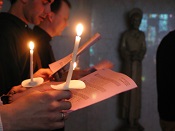 These are exciting times!
A brand new English translation of the complete Liturgy of the Hours [Divine Office] is about to be released.
Over fifty years ago, the revised version of the Latin Breviary (the set of daily texts prayed by ordained clerics and religious) was released in an English translation.
In the United States, the four-volume version of The Liturgy of the Hours was published in 1975, and opened the door, as envisioned by the Second Vatican Council, to a broader use of the Breviary — for the laity, not just for clerics and religious.
These are exciting times!
A brand new English translation of the complete Liturgy of the Hours [Divine Office] is about to be released.
Over fifty years ago, the revised version of the Latin Breviary (the set of daily texts prayed by ordained clerics and religious) was released in an English translation.
In the United States, the four-volume version of The Liturgy of the Hours was published in 1975, and opened the door, as envisioned by the Second Vatican Council, to a broader use of the Breviary — for the laity, not just for clerics and religious.
 Back to Liturgy Index
Submit Your Music / Contact Us / Company Description / Links