








|
| Musical Musings: Miscellaneous |
Frassati and Music
His spiritual life was solid and profound, rooted in a deep sense of service to the poor. From his First Communion in 1910 at the Church of Corpus Domini and his Confirmation in 1915 at his home parish, Our Lady of Grace, he went on to join various religious organizations:
Because of his family's cultural standing, Pier Giorgio was immersed in music and the arts and had a well-trained ear. He loved music and singing, although by all accounts those who heard his boisterous singing were not impressed! According to Christine Wohar, in Finding Frassati: Most of the music he heard was probably in the setting of a live perforamnce: a school or church choir, a band, a symphony, or an opera. He loved the works of Giuseppe Verdi, but had a broad range of music interest. For example, in less than one month in 1921, he saw three performances by three composers in three countries. In Germany, he saw Mignon, an opera by Amboise Thomas. In Prague, he enjoyed a well-performed Czech opera, Two Widows, by Bedrich Smetana. In Vienna, he saw Mozart's two-act masterpiece, Don Giovanni. He loved music. In 1922 the age-old Teatro Regio in Turin mounted a production of La Figlia di Re by Adriano Lualdi, starring Ester Mazzoleni and Enzio Pinza. "According to his sister (Lucianna), he was very moved by music, especially liturgical music," writes Wohar. But what was northern Italian liturgical music like in the second decades of the 20th century? These were the churches frequented by the young Frassati in Turin and the enirons:
The world had recently received the Moto proprio of Saint Pius X, Tra le sollecitudini (1903) on the subject of liturgical music. The pope called for a revival of Gregorian chant, with an active part for the congregation, and the restoration of sacred polyphony. The Cecilian Movement promoted the pope's ideals of chant and polyphony, particularly Palestrina, simultaneously rejecting modern theatrical music and secular-sounding repertoire. Proponents of these principles were Giovanni Battista Grosso and Pietro Yon, who would later emigrate to New York City and work at Saint Patrick's Cathedral. The Benedictine monks of Solesmes, France, took up the pope's challenge, with extensive study of Gregorian chant and the issuance of volumes of printed music, including the ubiquitous Liber usualis. It was more than likely that Pier Giorgio heard this music, particularly in the cathedral in Turin, which in his time housed the notable Shroud of Turin, and in later years, his own incorrupt body transferred from the family cemetery in Pollone upon his beatification in 1990. He was fond of meditating on the epistles of Saint Paul, particularly the "Hymn of Charity" in I Corinthians 13:
Maneant in nobis fides, spes et caritas, tria hæc: major autem horum est caritas. This is the seventh antiphon for the Foot Washing on Holy Thursday. It can be heard here, music as Frassati might have heard it. Near the end of his life, in 1920, an historic discovery led to the publication of 50 unknown choral works by Antonio Vivaldi, including the famous Gloria in D. These were housed in the National Library in Turin, and certainly made musical news in the city and beyond. Pier Giorgio died of polio at the age of 24. At his beatification Mass in 1990, Saint John Paul II called him, "A Man of the Eight Beatitudes." See the CNP music for flute and organ by Stephen McManus, The Beatitudes. Blessed Pier Giorgio Michelangelo Frassati was canonized by Pope Leo XIV in 2025, along with 21st century saint, Carlo Acutis. With them we can echo Colossians 3:16-17: Sing gratefully to God from your hearts in psalms, hymns and inspired songs. Whatever you do, whether in speech or in action, do it in the name of the Lord Jesus. Give thanks to God the Father through him. Article written 12 April 2026 |
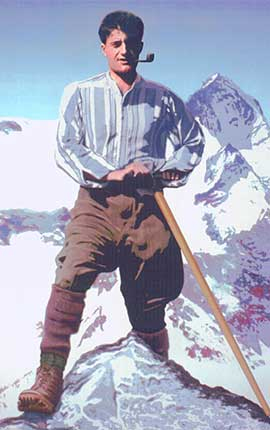 Pier Giorgio Frassati was a remarkable 20th-century saint.
He was born in 1901 in Turin, Italy, to an influential family — his mother was a noted painter and his father was the founder of the famous Italian newspaper, La Stampa, an Italian senator and ambassador to Germany.
For all this acclaim, the boy maintained a keen sense of humilty all his life.
He was a virile, handsome man who loved sports, hiking, mountain climbing, skiing, and horseback riding.
He was popular with his friends, perhaps foremost for his engaging personality, his convivialiy, his sense of humor, and his penchant for practical jokes.
A happy guy to be around!
Pier Giorgio Frassati was a remarkable 20th-century saint.
He was born in 1901 in Turin, Italy, to an influential family — his mother was a noted painter and his father was the founder of the famous Italian newspaper, La Stampa, an Italian senator and ambassador to Germany.
For all this acclaim, the boy maintained a keen sense of humilty all his life.
He was a virile, handsome man who loved sports, hiking, mountain climbing, skiing, and horseback riding.
He was popular with his friends, perhaps foremost for his engaging personality, his convivialiy, his sense of humor, and his penchant for practical jokes.
A happy guy to be around!
 Back to Miscellaneous Index
Submit Your Music / Contact Us / Company Description / Links